
Quick Summary
| Who this is for | Adults with ADHD working a fixed-schedule job |
| Core idea | Build a system around your energy and attention patterns, not the clock |
| Time to set up | 1-2 weeks of observation before changing anything |
| Key tools | Energy log, focus windows, external memory system, one habit at a time |
About 15.5 million U.S. adults — roughly 6%, or 1 in 16 — currently have an ADHD diagnosis, according to a 2024 CDC report. If you’re one of them and you also have a job that expects you at a desk from 9 to 5, you already know the productivity advice written for neurotypical brains doesn’t just fail to help — it can make you feel like the problem is you. It isn’t. Your brain runs on a different operating system, and it needs a system built for that, not against it.
Here’s one, built from current ADHD research rather than generic productivity wisdom.
Why standard advice falls apart for ADHD brains
Popular systems — rigid time-blocking, a fixed morning routine, “just make a to-do list” — assume steady attention, predictable energy, and an accurate internal sense of time passing. Research on adult ADHD consistently shows the opposite pattern: fluctuating focus, working-memory strain, and energy that shows up in bursts rather than a steady stream across the day.
The cost of the mismatch is measurable, not just anecdotal. Some workplace research puts the ADHD-related productivity gap at roughly 22 additional missed workdays a year compared to neurotypical peers, and one widely cited long-term study links unmanaged adult ADHD to a meaningful income gap over a career. Whatever the exact figures in your own life, the pattern is consistent: this isn’t a motivation problem, it’s an executive-function mismatch with how most workplaces are structured.
There’s also a hidden cost on the other side — hyperfocus. When you finally lock onto something, it can feel like a superpower, until you look up and realize you missed two meetings and your inbox is on fire. A workable system has to protect hyperfocus and put guardrails around it.
The system: six pieces that hold together
1. Track energy, not just time
Before changing anything, spend a week just observing yourself — no changes yet, just data. Note when you feel sharp, when you feel foggy, when you crash. Most adults with ADHD have real peaks and valleys that don’t line up with a 9-to-5 shape. Once you see your pattern, put your hardest, most cognitively demanding work in your peak windows, and save email, admin, and low-stakes tasks for the valleys.
2. Build “focus windows,” not fixed schedules
Instead of “Project X from 10:00–11:00,” try “Project X gets the next focus window, whenever that naturally starts.” A focus window is protected, single-task time that begins when you’re actually able to engage — not when the clock says so. This small reframe removes the guilt spiral of “I’m behind schedule” and replaces it with something your brain can actually use.
3. Protect hyperfocus instead of fighting it
When hyperfocus kicks in on something useful, don’t interrupt it to “stay on schedule” — that’s often your most productive hour. Instead, build in an external circuit-breaker: a phone alarm at a set time, or a coworker who knows to check in. The goal isn’t preventing hyperfocus, it’s making sure it doesn’t quietly swallow the whole day.
4. Externalize everything you’d normally “just remember”
Working memory is one of the first things to buckle under ADHD, so the fix isn’t trying harder to remember — it’s getting things out of your head entirely. A visible task board, a single running notes doc, or a timer sitting on your desk all do the same job: they hold information so your brain doesn’t have to.
5. Stack one habit at a time
The instinct after reading an article like this is to overhaul everything on Monday. Don’t. Systems that stick are usually built one habit at a time, added on top of something already automatic — write your daily task list first, and only once that’s routine, add a five-minute end-of-day review on top of it.
6. Say the quiet part out loud at work — strategically
You don’t need to over-explain your ADHD to your manager, but naming a specific need in terms of output tends to land well: “I noticed I get more done in the quiet hours before everyone arrives — could I shift my start time?” is a request framed around results, not a diagnosis. Many workplaces are also required to provide reasonable accommodations under disability law, so if a formal request would help, it’s worth knowing that option exists — HR or an occupational health provider can walk you through what’s available.
ADHD’s impact doesn’t stop at the office door — it can also affect everyday tasks like driving, where focus and impulse control matter just as much as they do at your desk. If that’s something you or a loved one navigates, this guide on ADHD and driving covers practical strategies for staying safe behind the wheel.
A sample day, put together
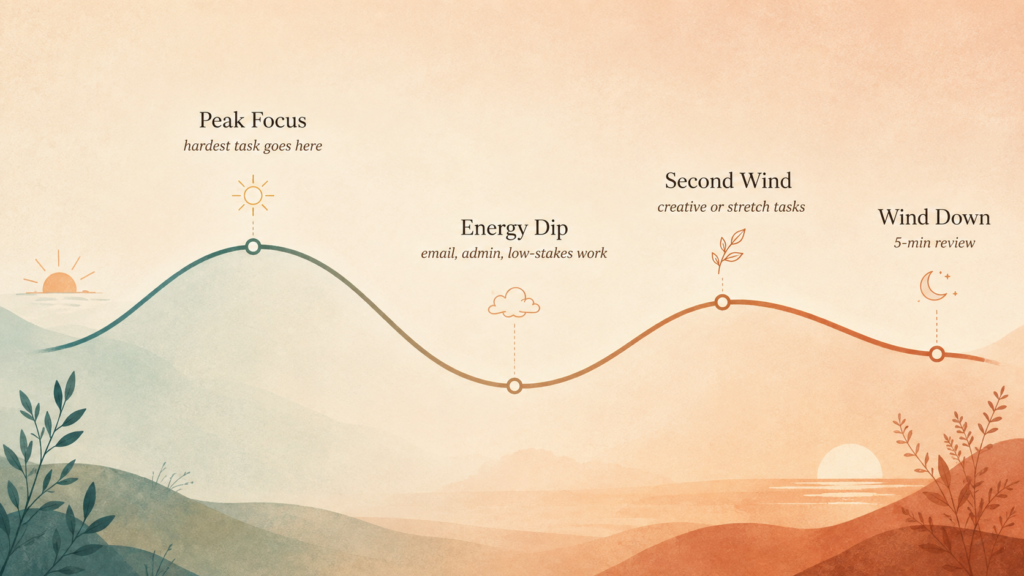
- Start of day: 5-minute brain dump — everything on your mind onto one list, no sorting yet
- Peak energy window: the one task that actually matters today, protected from interruptions
- Energy dip: email, Slack, admin — the stuff that doesn’t need your best brain
- Second wind (if it shows up): a stretch task or creative work
- End of day: 5-minute review — what moved, what didn’t, one thing to carry to tomorrow
This isn’t a rigid schedule — it’s a shape. Some days will follow it loosely, some days will fall apart by 11 a.m. That’s normal, and the system is meant to survive bad days, not depend on perfect ones.
The real goal
None of this is about becoming a neurotypical productivity machine. It’s about building a system your actual brain can run on most days, with enough grace built in for the days it can’t. If you’re finding that no system helps and work stays consistently overwhelming, that’s worth a conversation with a doctor or therapist who understands ADHD — this article is a starting framework, not a substitute for that kind of support.
Sources
- CDC / National Center for Health Statistics Rapid Surveys System (2023-2024) — via CHADD: General Prevalence of ADHD in Adults
- ADHD in the Workplace Statistics 2026 — workplace productivity and income data
- ADDA (Attention Deficit Disorder Association) — 15 Good Work Habits for Adults with ADHD
- ADDitude Magazine — 9 to 5 with ADD: Practical Work Strategies for Clever ADHD Brains
- Elevating Minds Psychiatry — ADHD at Work: 7 Proven Strategies for Career Success
This article is for general informational purposes and isn’t a substitute for advice from a licensed medical or mental health professional.